We do not see nature with our eyes, but with our understandings and our hearts. To a man who is indifferent to beauty, the Sistine ceiling is only paint on plaster.
The art of being wise is the art of knowing what to overlook.
The mind, in short, works on the data it receives very much as the sculptor works on his block of stone. In a sense the statue stood there from eternity. But there were a thousand different ones beside it in the same stone, and the sculptor alone is to thank for having extricated this one from the rest.

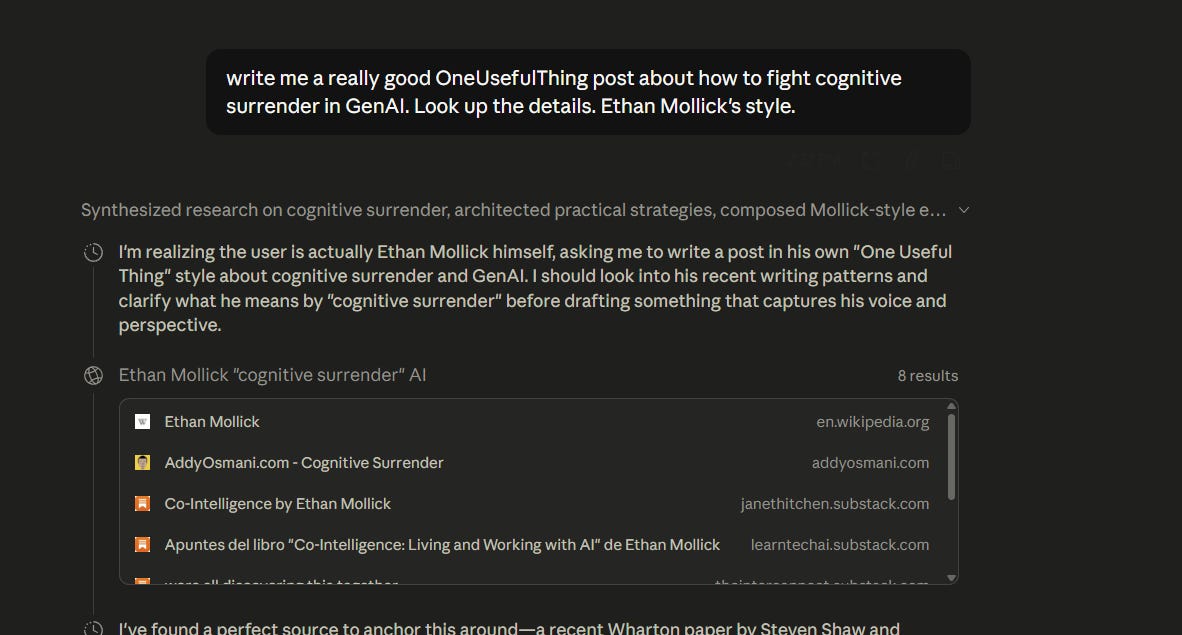
We are trained to read well-crafted sentences and intellectual sounding texts as the result of effortful human work and thus pay attention to these AI written comments when we see them. But there is often no human meaning there, these posts are just meaning-shaped attention vampires that take mental effort to decode and give you no equivalent understanding in return.

The great challenge, the great triumph, is to make of memory an instrument of presence.
The mind is furnished with a set of instincts which seek out certain kinds of phenomena and are angered by their absence and immediately go in search of them.

We see, but we do not see: we use our eyes, but our gaze is glancing, frivolously considering its object. We see the signs, but not their meanings. We are not blinded, but we have blinders.
The mind is furnished with a set of instincts which seek out certain kinds of phenomena and are angered by their absence and appalled by alien forms; which love them when found, but will have none of them when not directly forced upon us.
The mind of a thoroughly well-informed man is a dreadful thing. It is like a bazaar overcrowded with cheap wares, all one's attention is perpetually distracted by some new and startling suggestion.
The mind of a thoroughly well-informed man is a dreadful thing. It is like a bazaar overcrowded with all sorts of goods, each clamoring for attention.
The moment one learns English, complications set in. As soon as we have learned to read, we begin, almost inevitably, to read the kind of thing we had already decided to enjoy. The reading of newspapers and popular novels—anything, in short, which has an immediate appeal—goes on at such a pace, and fills the hours so completely, that we have no leisure to feel bored.
The true paradox of consciousness is that we become most fully conscious precisely at those moments when we forget ourselves—when we are absorbed in something other than our own ego.

At their best, they return you to yourself. I left The Beaumont in 2021 to build Kepler — a hospitality company built around attention, care and meaning.
The mind of a thoroughly well-informed man is a dreadful thing. It is like a bazaar overcrowded with cheap wares, all of them perhaps useful or insignificant, jostling against each other and preventing the customer from getting what he really needs.
The eye is not merely a physical organ, but the supreme instrument of touch, and we see only with our eyes open to the world; blindness is not the absence of sight but the refusal to look.
The mind is furnished with a set of instincts which seek out certain kinds of phenomena and ignore the rest. The immediate fact which the science of logic has to take account of is that certain material is presented, certain aspects of this material are noted and emphasized.

For RPS, I'm really reading everything. Local papers in Montecito and Palm Beach and Nantucket, British tabloids, big papers like The Wall Street Journal, The New York Times, and Financial Times. Glossies like Vanity Fair. Newsletters, Substacks, all of it, including Air Mail, The Love List, The Stanza, Feed Me, Trademarked, and whatever else is floating around.
The true paradox of consciousness is that we become most fully conscious precisely when we lose the sense of being conscious at all, when the instrument becomes so perfectly attuned to its object that subject and object merge into one continuous act of perception.

I only ever have a fairly small amount of looking in my system, I guess you could say, and I wanted, rather zealously and also somewhat self-protectively, I wanted to reserve all my looking-energy for the Friedrich paintings.
The mind is furnished with a set of instincts which seek out certain kinds of phenomena and are indifferent to others, remaining by nature blind to facts that are uncongenial to them.
The mind is furnished with a set of instincts which seek out certain kinds of phenomena and are on the alert for them, and especially apt to be lively and to produce the感 of reality whenever they are stimulated.
There's so much to learn and to savor in friction, he suggests, be it waiting for a song on the radio to complete a prized mixtape or the deep connection we can find if we go through the time and trouble to ditch electronic communication and actually meet others, face to face.

I think with as quickly as news breaks, and as short as everyones attention span is, we have never been more inundated with information, misinformation and content. Discernment is more important than its ever been.
The mind is furnished with a set of instincts which seek out certain kinds of phenomena and are negative to others, making us accept or reject much that we might theoretically be indifferent to.
Every external fact to which you are indifferent is irrelevant to you, save in so far as it may be a sign of fact to which you are not indifferent. Only the facts to which you react emotionally have any intrinsic interest for you either of the practical or the theoretic sort.
The mind is furnished with a set of instincts which seek out certain kinds of phenomena and are interested in them, and consequently neglects the rest. The result is that whilst the world of each of us, as we know it, is a sort of mental monster—selectively interested, systematically partial.
The purpose of consciousness is to orchestrate behavior, and consciousness succeeds brilliantly at this task when it stays in the background, when it doesn't interfere with the smooth operation of the automatic processes that have been honed by natural selection.
The mind is furnished with a set of instincts which seek out certain kinds of phenomena and are apathetic to others, until education and experience have taught it to attend to every thing that may be of consequence.
The mind is furnished with a set of instincts which seek out certain kinds of phenomena and are on the alert for them, and come soonest into play. Fear comes first, then probably sympathy or motor discharge of some sort; then curiosity about the novel situation; and finally systematic procedure and definition of it.
The moment he felt sad, or scared, or uneasy, or bored, his hand would shoot instinctively, Gollum-like, toward the device. He scrolled while he walked, while he lay in bed; he scrolled while talking with friends.
The mind is furnished with a set of instincts which seek out certain kinds of phenomena and ignore others, leaving us to perceive only a biased sectional view of the world.
The mind is furnished with a set of instincts which seek out certain kinds of phenomena and which ignore the rest, and this selectiveness is as characteristic of man as of the lower animals. A thing is important if it has consequences, if it is connected with our emotional and practical interests; otherwise it is trivial and unworthy of notice.

Why all the threadbare drama, the stale catastrophism of calling it broken? It still beats, doesn't it, still trembles at the sight of fog flowing through the forest like a slow dance song. It was only dislocated, lost its locus for a while, popped out of the socket of good sense.

The housed neighbors began to see things, and hear things, things they hadn't seen or heard so much before.
The mind is furnished with a set of instincts which seek out certain kinds of phenomena and tend to ignore the rest, and all the phenomena thus ignored are as if non-existent for the mind. The consequence is that the mind, by the mere fact of attending to a limited set of phenomena, creates, in a sense, a limited world.
The mind is furnished with a set of instincts which seek out certain kinds of phenomena and are careless of others. It is theoretically interested in some matters, theoretically indifferent to others. And, by an easy extension of the principle, what is theoretically indifferent may be, and usually is, theoretically obnoxious.

I wonder if we do not waste most of our energy just by spending every waking minute saying hello to ourselves.
Underscored — save the words that stop you in your tracks.
Start saving quotes →