'I'll write a summary: "Guys, I only have 24 hours to myself. You have so many engineers, add up how much time you guys have. Why don't you guys find those bugs? Why have only me find those issues?"'
The harness handles evidence gathering, root-cause analysis, and follow-up artifact creation, all without me needing to type "dear agent, please fix this bug" ever again.
When AI does the building, coordination overhead doesn't scale the engineering; it just slows it down. The key: strip process to what the team actually needs, then let AI fill the gap.
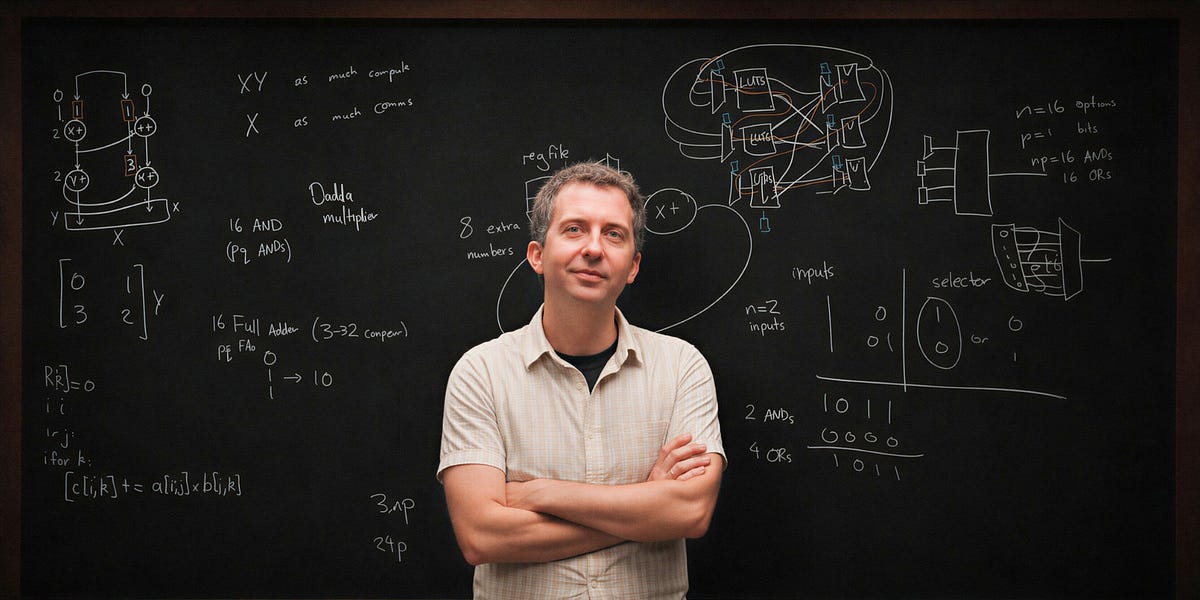
The other observation is that the precision will almost always be higher in the accumulation step than in the multiplication step. This is specific to AI chips. You're multiplying low-precision numbers, and then when you accumulate, errors accumulate quickly, so you need more precision there.
There's a crucial difference between asking AI to categorize things repeatedly versus using it to build code that handles structured data through APIs. Yash used OpenClaw to build a Slack digest that pulls notifications via API endpoints—AI built the tool once, but the categorization runs on deterministic code (except for the final action/read/FYI sorting).
If I had to venture a theory, I'd say that because AI is allowing engineers to move so quickly, there's less opportunity—and less desire—to involve the traditional design process.
One rebuttal — which I happily ascribe to — is to reply with an image of Las Vegas Sphere and say, "yes, we definitely do." Look, the latter might not be the Cathedral Notre Dame or La Sagrada Familia…or the Forbidden Palace. But it's still a different kind of marvel and incredible engineering accomplishment.
It's rare for our engineers to look at a banking API and say, 'wow, this is one of the best we've ever seen,' says Mercury co-founder and CEO Immad Akhund.
6mo ago
Underscored — save the words that stop you in your tracks.