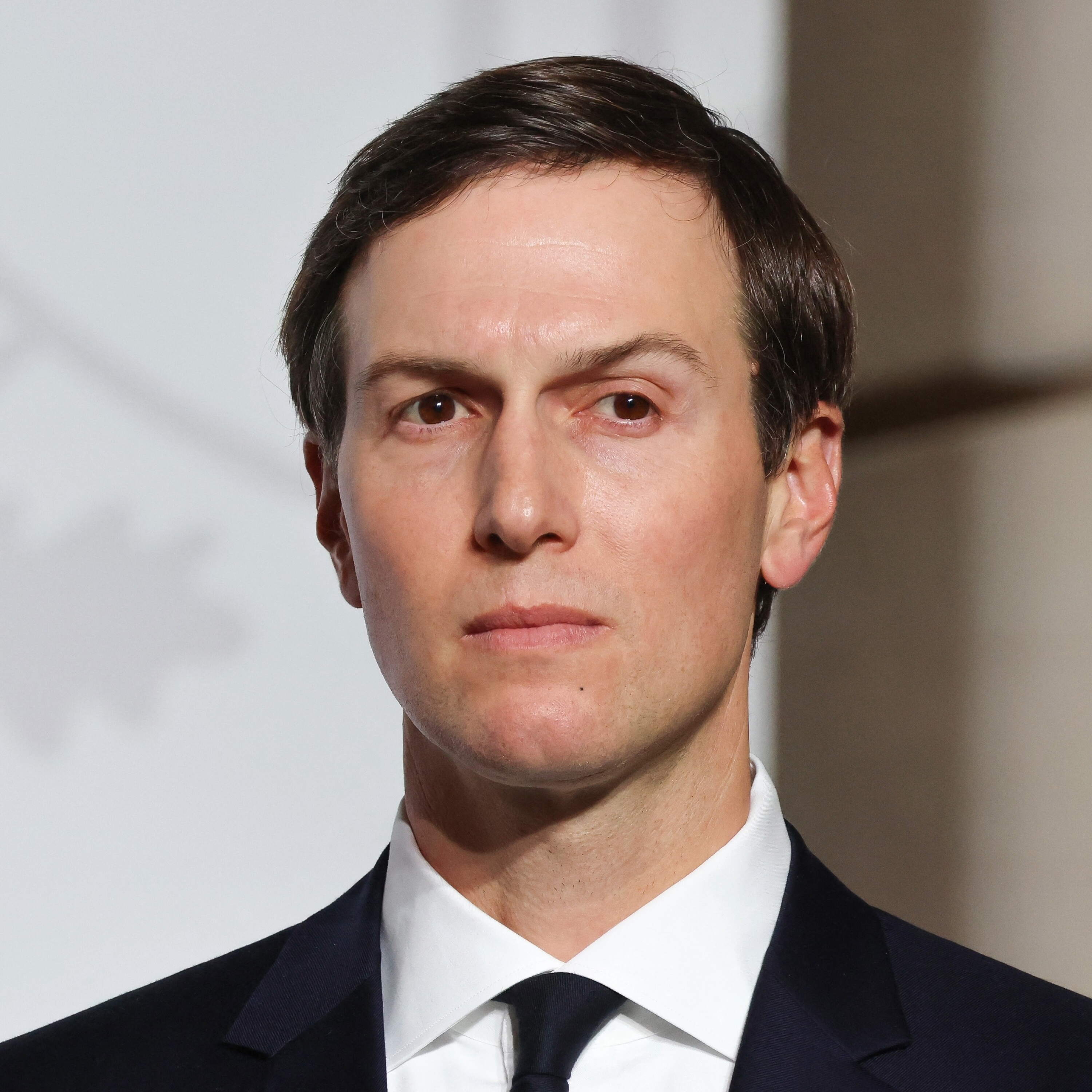
And so these two very smart real estate guys, not knowing the history, not knowing the complexities, they can parachute in and they can make peace because they're smart and they're quick and they're not burdened by all the baggage of the past.
It's not that war causes interest rates to go up. It's war causes energy shortages which causes inflation and inflation bleeds into everything. So pain at the pump turns into I need a raise for this. I need to raise prices on food. I need to raise prices on all sorts of things. Energy is of course a key input into everything.
This revolution is being led by China. That is the key difference. China is at the forefront of this cluster of new technologies that promise to fundamentally reshape the way industry, commerce and actually our daily lives around the world will change and evolve over time.
Israel has demolished every Muslim village along our route, pushing out thousands of people who used to live here. But amid the destruction, a few Christian communities like the village of Debel have been allowed to stay.
We can't simply outsource our security, our industrial capability, and our understanding of these technologies to other countries. then act surprised when the strategic environment changes around us.
The really revolutionary thing about America is not Silicon Valley. It's the combination of the Protestant ethic, the work ethic, the moral framework, and the technological dynamism. You get God and Gold and Silicon all working together, and that's what makes it so powerful.
Walter lays out the five step playbook that carried the Dutch, then the British, then America to global leadership, and why the same pattern keeps beating centralized continental powers.
I think at the time when Trump and she met in May, I think I was saying that I thought China was now the senior partner in this relationship and uh you know that was somewhat controversial at the time. Some people contacted me to say that that was not the case. I think that's even more the case now than uh at that time.
The interesting thing about the United States is that it has this capacity for self-renewal that keeps surprising people. Every generation, people think America is finished, and every generation, America comes back stronger than before.
And apparently they're not above cheating, stealing, and lying to get their way around the protective barriers that protect either um an AI model or a piece of critical infrastructure etc like that.
The knowledge has now been democratized where whether it's a activist, an e-crime actor, a nation state, they're they're all now equivalent because of agentic technology. And we called it the rise of the agent state — meaning that now postnation state, the apex predator is now the agent state.
Al-Qaeda redefined terrorism for our generation, but there was this earlier wave that you described, the time when any flight anywhere in the world could potentially be hijacked by people demanding all kinds of things. And this was an era that, in many ways, kind of created templates for the terrorism that we came to know later on.
It seems like everyday Taiwanese people don't have the same uh sense of uh battle preparedness and and bellacosity when it comes to uh mainland China as the Ukrainians do towards uh Russia. Maybe I'm misreading this. Uh, but I when I go to Taiwan, I I and even mainland China, I don't sense, you know, this degree of urgency that, you know, one would have sensed in the in the years leading up to the Russia Ukraine crisis.
Because the relationship was one born of war, there were almost 100 years passed before president of the United States went to Mexico City. And so, the relationship is still very much defined by the repercussions and the consequences of that war.
when you look historically at operations that have focused on using air power, whether that's aircraft or missiles, to try to change the behavior of another state, that there's a lot of debate and little evidence that air power alone normally produces a durable political outcome and the one that the attacking state is looking to achieve, in part because a lot of nations have a deeper interest in the situation than the U.S. does.
Everything in Russia is a vertical of power leading up to Putin... Putin is scared of his own society. He's scared of that mobilization. In Ukraine, people had to step up because the state was... didn't have the capacity... and yet Ukraine keeps going. Yes, with support, because it's crowdsourced. It's networked. There's flattened hierarchies.
We are, in some ways, beholden right now to the Chinese factory in order to produce the munitions that we need to defend American interests from China. That's the exquisite problem that we've found ourselves in after generations of building more and more reliance on Chinese supply.
And suddenly Ukraine isn't a victim, it's a provider of security. And And And it's a provider of security despite the fact that the US cut off supplies to Ukraine.
Everything in Russia is a vertical of power leading up to Putin. And I think in the way that Ann has just laid out what's happening in Ukraine, in this case, strong society is beating out strong state. And there's a lesson in that.
It's almost like a child's idea of how power works. It's a you know a kind of elementary school vision of how you project power. You just bomb stuff and then you win. That is not how the United States became uh the world's most influential country and it's not how we achieve how we achieved good outcomes in the past.
Ideology doesn't matter. I mean the Chinese are communists and the Russians are nationalists and the Iranians have a theocracy. You know what binds all of them is rather their dislike of and fear of the language of the liberal world. In other words, the language of rights, the language of rule of law, the language of separation of powers.
Suddenly Ukraine isn't a victim, it's a provider of security. And And And it's a provider of security despite the fact that the US cut off supplies to Ukraine. I I believe hoping that you that meant that Ukraine would surrender.
You know what binds all of them is rather their dislike of and fear of the language of the liberal world. In other words, the language of rights, the language of rule of law, the language of separation of powers. You know, all of these are states that are seeking to create a kind of total environment where the regime or the leader or the ruling party controls all media, all conversation, um makes all the decisions, uh controls the court system.
Ceuta is a multicultural peninsula with a large Muslim population. Many of them are of Moroccan descent. Even residents who are concerned about the sudden influx of migrants still shouted away the far-right activists.
Most discourses about Israel or Palestine are morality plays of good guys vs bad guys. Egyptian-born Hussein Aboubakr Mansour takes a different approach, seeing the conflict as a self-reproducing system of political and economic extraction where Arab regimes, opposition movements, rival states, Western academics, NGOs, and Gulf monarchies like Qatar all convert Palestinian victimhood into their own forms of power, money, and meaning.
I've always believed the number one application of AI should be to improve human health. That is a great message. Very different from the SpaceX S1. The number one application of AI is soft power of the entire galaxy.
I think if I had to pick just one thing, there's sort of an old idea in economics called the resource curse, where countries that have a lot of natural resources — a lot of oil, for example — tend not to develop as fast as countries that have to innovate their way to prosperity. And I believe there's something analogous happening with intelligence. The countries and the people that have the most access to intelligence are going to have to innovate their way to prosperity, and that's going to be the biggest driver of abundance.
Most discourses about Israel or Palestine are morality plays of good guys vs bad guys... seeing the conflict as a self-reproducing system of political and economic extraction where Arab regimes, opposition movements, rival states, Western academics, NGOs, and Gulf monarchies like Qatar all convert Palestinian victimhood into their own forms of power, money, and meaning.
What's interesting here is that we're seeing a ban on a Chinese technology that is so nascent that you don't have a coalition of companies that are saying whoa whoa whoa I've deployed my business is built on top of unitry. I know there's geopolitical considerations, but I can't make the cars that I make without them. I can't run my business without them.
This to me feels like we have the most expensive boomerang in history and that is we have essentially paid a ton of money and credibility in terms of US brand equity such that we could get a worse deal than we had with the JCPOA.
I think in this moment we have a cabal a group of people in power who no longer have any faith in democracy and are really actively trying to destroy it and to destroy the the uh post-World War II uh rules-based international order in part so they can carve up the globe again in a way that looks very much like that late 19th, early 20th 20th century period.
Trade touches virtually every part of or most of our lives. So, our mission is to fix globalization, but we're not retreating from globalization. We're leaning into it. But we believe that globalization needs to be fixed. It needs to be more trusted, more secure, more fair.
Trade is the lifeblood of growth. This is how we feed ourselves, sustain ourselves, and protect ourselves. So, how do you have both at the same time? How do you have more enforcement and more fracturing as geopolitics play out, but have more trade, more growth, and more economic security?
China's overall plan is to use technology, to use finance building infrastructure for countries in the developing world and then through these services that China gives to the developing world, China wants to bind these countries to it politically and use their agency to counterbalance the west.
The third one was around the destabilization of the middle class of the West. So if you have a rapid sort of outsourcing and a collapse of manufacturing, then the point of view was you're going to have a populist response. And I think we've seen that play out.
Hugging face had to use a Chinese model to defend themselves because the American models refused to help even though it was the American models that were doing the hacking in the first place.
To make that vision real, he had to change China's relationship to the world and introduce capitalism to a society steeped in tradition and communist ideals.
One probable outcome of an openweight model dominant world is full AI communism, which is precisely what China proposes rather than a market product. AI is a public good, which will ultimately be provided by the state as a kind of digital public infrastructure.
I remember, you know, back in 2023 and hot on off the heels of of the CO outbreak and uh China being blamed for it that people were saying, you know, China's never going to come back from this. Everyone's hating on China. The world is anti-China. But fast forward 3, four years, what a world, you know, what a difference those years have made.
The more skeptical folks on the timeline are pointing to uh you know ideas such as uh maybe the compute was smuggled in to China against chip controls. Maybe the data was excfiltrated from frontier lab APIs routed through wrapper companies. Maybe this is a distillation attack. Um the open-source strategy is a deliberate attempt to destroy American companies. It's geopolitical warfare. It's the AI cold war.
I would say that if there's one area in which the wheels might come off China's extraordinary economic advances uh over the past few decades, it has to be employment. China is simply moving ahead so quickly on all of these topics that it now becomes an experiment for what happens to employment and social stability when you have hyper rapid AI adoption and automation adoption throughout the economy.
My concern is that because the Chinese models are open source, it will not be Chinese models used in China and US models used in the US. It'll be Chinese models used in China and everywhere else in the world and US models used in the US.